Verification & Testing
How the engine is verified — unit tests, differential parity, the W3C gates, benchmarking, and debugging the query pipeline.
The verification pyramid
      W3C differential gates        test/w3c/ (vs Comunica + spec results)
    Differential parity             test/parity/ (vs Comunica, 1:1)
  Unit / integration tests          src/**/*.test.ts
Typecheck + lint + fmt + parser     deno task check / lint / fmt:check / parser:check
Every layer runs in CI (.github/workflows/ci.yml): the ci job runs
deno task ci (plus explicit test:exists-ref and publish:dry steps),
w3c-parity runs deno task test:w3c + deno task test:exists-ref,
latency-snapshot re-checks the committed bench inventory, docs-drift
enforces the wiki’s detail_level guardrail (L<line> citations fail),
docs-links fails on wiki link rot, and publish.yml gates deno publish.
Task reference
| Task | Command | What it runs | Gating |
|---|---|---|---|
deno task test |
deno test --allow-all |
All unit + integration + parity *.test.ts files |
ci |
deno task check |
deno check |
Typecheck the package | ci |
deno task fmt:check |
deno fmt --check |
Source and markdown formatting (width 80) | ci |
deno task lint |
deno lint |
Lint | ci |
deno task parser:check |
generate-parser.ts --check |
Generated parser.ts in sync with sparql.jison |
ci |
deno task bench:check |
bench/budget.ts |
Perf regression budget (vs bench/baseline.json) |
ci |
deno task test:exists-ref |
test/w3c/exists-ref.ts |
EXISTS/NOT EXISTS subquery surface vs Oxigraph | ci + w3c-parity |
deno task test:sparql12:gap |
test/w3c/sparql12-gap.ts |
RDF 1.2 eval-triple-terms gap suite | ci |
deno task test:sparql12 |
test/w3c/sparql12-main.ts |
W3C SPARQL 1.2 evaluation suite | ci |
deno task test:rdf11 |
test/w3c/rdf-differential.ts |
RDF 1.1 Turtle/TriG/N-Triples/N-Quads vs n3 | ci |
deno task test:rdf12 |
test/w3c/rdf-classify.ts |
RDF 1.2 syntax classifier | ci |
deno task publish:check |
test/publish-graph-check.ts |
Default export graph has no node:/npm: runtime imports |
ci |
deno task ci |
— | All of the above in dependency order | ci job |
deno task test:w3c |
test/w3c/w3c-main.ts |
SPARQL 1.1 evaluation-core differential vs Comunica | w3c-parity job |
deno task docs:link-check |
docs/link-check.ts |
Wiki link rot: every external markdown link (JSR/GitHub/W3C/…) must resolve (404/410 fails) | docs-links job |
deno task bench:latency:check |
bench/latency-check.ts |
Committed bench/latency-data.json bench inventory matches a fresh run |
latency-snapshot job |
deno task test:ref |
test/w3c/ref-crosscheck.ts |
Allowlisted divergence audit vs Oxigraph + N3.js | manual (on grammar change) |
deno task bench |
deno bench --allow-all |
Three-engine benchmarks | manual |
deno task bench:latency |
bench/latency-chart.ts |
Render | |
bench/latency-data.json → docs/assets/chart-latency.svg |
manual | ||
deno task publish:dry |
deno publish --dry-run |
JSR publish validation | ci |
| job + publish job |
Unit & integration tests
deno test discovers *.test.ts alongside sources and under test/:
deno test src/              # engine internals only (fast loop)
deno test src/wazoo-sparql-engine.test.ts   # single file
deno test -n "exists"       # filter by test name substring
Covered areas: parser (src/parser/mod.test.ts, turtle-parser.test.ts), store
semantics (src/store/memory-store.test.ts), quad-store adapters
(src/quad-store.test.ts), the join engine (src/evaluator/join.test.ts), the
planner (src/planner/*.test.ts), term algebra (src/term/term.test.ts),
serializers (src/serialize/*.test.ts), updates
(src/evaluator/update-evaluator.test.ts), and the engine integration suite
(src/wazoo-sparql-engine.test.ts) — including the concurrent-execute()
isolation tests for the EXISTS snapshot (issue
#72).
Differential parity (the project’s core test)
The parity contract is behavioral equivalence with
@comunica/query-sparql-rdfjs-lite, the engine this project ports 1:1. See
test/parity/parity.test.ts and parity-update.test.ts:
- Each case seeds both engines with identical RDF/JS stores, runs the same query, and deep-compares observable results: SELECT bindings (with ORDER BY emission order compared exactly), ASK booleans, CONSTRUCT quads, and — for updates — final store contents.
- Blank nodes compare by identity, not label. Comunica skolemizes blank-node
labels to
bc_<sourceId>_<label>; the harness strips the prefix (normalizeComunicaBlankNodeLabelintest/parity/parity-harness.ts) because SPARQL 1.1 result semantics treat labels as scoped and opaque. A dedicated test locks in this known difference against real Comunica output, so the normalization stays verified rather than assumed. - The canonicalization itself is unit-tested:
test/parity/canonical-store.test.tslocks incanonicalStoreQuads’ blank-node substitution — repeated placeholders within one quad (replaceAll, e.g. the same blank node bound as subject and object), distinct-node preservation, and multi-quad isomorphism under relabeling. - CONSTRUCT compares under the graph-result contract (issue
#87). A CONSTRUCT
result is a set of triples: the reference side (Comunica) is normalized to
graph content — its stream may repeat a triple its graph would not — while the
wazoo side is compared as-emitted. A conforming engine emits no duplicate
quads (W3C decision #29), so a change that starts emitting duplicates fails
the gate instead of silently passing;
test/w3c/construct-semantics.test.tspins the contract with unit tests oncompareConstructRecords/dedupeRecords(test/w3c/runner.ts). - Updates canonicalize stores up to blank-node relabeling — two stores pass when they agree exactly modulo label identity (the SPARQL contract, since INSERT DATA mints fresh labels per execution).
- Spec-wins divergences: when Comunica contradicts the spec (e.g.
LIMIT 0ignored, malformed regex throwing), the wazoo engine implements the spec, documents the divergence, and skips the parity case — seetest/w3c/divergences.ts.
W3C suites
deno task test:w3c runs the vendored W3C SPARQL 1.1 evaluation-core
(aggregates, bind, bindings, cast, construct, exists, functions, grouping,
negation, project-expression, property-path, subquery, and the update
categories) differentially: every query runs through both Comunica and the
wazoo engine, and observable results are compared. Categories per test:
pass— both engines agree.gap— wazoo and Comunica disagree; the gap count is the tracked progress metric and the gate stays red until it reaches zero.error— the runner itself failed.documented divergence— keyed indivergences.ts; validated against the W3C reference result instead of Comunica.conformance— soft cross-check of the spec-expected result where parseable.
The SPARQL 1.2 gates are similar but larger-surface: test:sparql12
(differential vs Comunica, including the four direction functions and RDF 1.2
triple terms) and test:sparql12:gap (the RDF 1.2 eval-triple-terms gap suite,
where Comunica’s parser lags).
The RDF syntax gates validate the in-repo Turtle/TriG/N-Triples/N-Quads parser
backing LOAD:
test:rdf11— differential vsn3@2.2.0on accept/reject and resulting quads (up to blank-node relabeling); negative tests are gated absolutely.test:rdf12— manifest classifier: positive syntax must parse, negative must be rejected, eval tests must be isomorphic to their.nt/.nqreference.test:ref— audits every allowlisted divergence against Oxigraph and N3.js so no accepted-but-universally-rejected construct slips in.
All fixtures are vendored under test/w3c/fixtures/ (no network needed);
refresh instructions live in test/w3c/README.md.
Benchmarking
Each tool’s methodology is on the dedicated
07 — Benchmarking & Performance page (the measured numbers
live in the root README.md); this section covers how to run each tool and what
it gates.
deno task bench — three-engine comparison
bench/engine_bench.ts compares the wazoo engine against
@comunica/query-sparql-rdfjs-lite and Oxigraph (WASM) over an identical
generated graph (400 people, ~1,600 quads, plus named-graph datasets).
Two properties make the timings trustworthy:
- Verification first. Before any timing, every query asserts all three
engines return identical results (
verifySelectEquality,verifyAskEquality,verifyConstructEquality,verifyConstructIsoEquality— CONSTRUCT under the graph-result multiset contract: reference deduplicated, wazoo as-emitted (issue #87) — and every update asserts identical final store contents on fresh stores (verifyUpdateEquality). A benchmark of a broken engine fails loudly, not silently. - Self-restoring updates. The timed update deletes and re-inserts the same quads, netting to zero per iteration, so the benchmark stores never drift.
Groups cover the feature surface: scan, join, asym-join (reorder on/off),
reorder-chain, ask, construct, update, optional, minus, union, path,
group-aggregate, filter-expr, order-limit, distinct, values-bind, graph, from,
subquery, exists, cast, string-fn, having, reduced, update-ops. The
reorder-chain group demonstrates the dynamic join planner (see
07 — Benchmarking & Performance): reordering makes the
worst-case-ordered chain fast, at parity with Oxigraph.
deno task bench:check — regression budget
bench/budget.ts runs two queries (a 2-pattern BGP join and a reorder chain)
50× against a 100-subject store and fails if average latency exceeds
maxAllowedMs: 50 from bench/baseline.json. This is the CI perf gate.
bench/concurrency-probe.ts — EXISTS concurrency stress
Standalone probe for issue #72 (a concurrent execute() must never observe
another call’s EXISTS snapshot rebuild). Five queries cover the EXISTS surface —
flat, NOT EXISTS, nested, ORDER BY, and GROUP BY + OPTIONAL — over a
300-subject store:
- Static-store concurrency — 40 rounds of the shuffled query mix run via
Promise.all, asserting every round matches the sequential baseline byte-for-byte. - Update interleaving — 20 rounds of a self-restoring DELETE/INSERT UPDATE running concurrently with EXISTS queries, asserting no call errors (exact results are undefined mid-mutation).
Any error or divergence exits 1:
deno run --allow-all bench/concurrency-probe.ts
The same guarantees are locked in as unit tests in
src/wazoo-sparql-engine.test.ts.
deno task bench:size / bench:size:closures / bench:memory — footprint measurement
Latency is only half the story: the engine is also benchmarked on what it costs
to ship and run (root README.md → Size & memory footprint):
bench:size—bench/measure-libs.tsmeasures the on-disk footprint a consumer must install: the wazoo JSR artifact (zero runtime deps) vs the Oxigraph npm package vs Comunica’s full transitive closure →bench/size-data.json. The JSRpublish.excludeset (grammar sources,generate-parser.ts) is applied before measuring, so the number is what consumers actually install.bench:size:closures—bench/measure-closures.tswalks the value-import graph of each package entrypoint (.,./term,./store,./parser,./serialize), skipping type-only imports, and reports the total local bytes each one loads (from the serializers to the full engine) →bench/closures-data.json.bench:memory—bench/collect-memory.tsspawnsbench/memory-probe.tsper engine in an isolated Deno subprocess (so only the target engine is loaded), reporting peakDeno.memoryUsage().heapUsedover 5 runs on a 10k-person graph (~55k quads), across a full-scan and a nested-EXISTS workload →bench/memory-data.json. Wazoo is lowest on both workloads.bench/treemap.tsrenders the JSON snapshots intodocs/assets/chart-*.svg(bar charts) anddocs/assets/treemap-memory.svg(treemap):
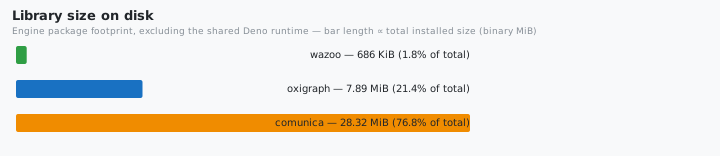
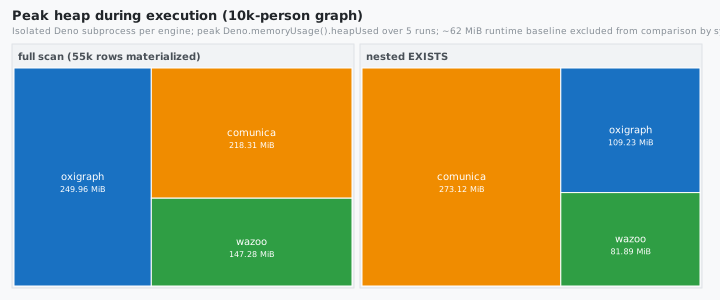
These are machine-specific snapshots, not guarantees — regenerate with the three tasks above and commit the updated SVGs.
Debugging guide
1. Inspect the parsed AST (the “query plan”)
The engine has no separate algebra IR — the sparqljs AST is the closest thing to a query plan. Dump it:
deno eval '
import { SparqlParser } from "./src/parser/sparql-parser.ts";
const ast = new SparqlParser().parse(
  "SELECT ?city (COUNT(*) AS ?cnt) WHERE { ?s <http://example.org/city> ?city } GROUP BY ?city HAVING (COUNT(*) > 1) ORDER BY ?city",
);
console.log(JSON.stringify(ast, null, 2));
'
You can see the algebra operators the evaluator will run: group + having +
order + projection expressions map 1:1 onto
applySelectPipeline()
stages (see 02 — Architecture).
2. Inspect what the store sees
The engine evaluates over any rdfjs.Store. Dump the store the evaluator uses
to check scoping:
deno eval '
import { DataFactory, MemoryStore } from "./src/mod.ts";
const { namedNode, literal, quad } = DataFactory;
const store = new MemoryStore();
store.addQuad(quad(namedNode("https://e/s"), namedNode("https://e/p"),
  literal("o"), namedNode("https://e/g")));
console.log(store.getQuads(null, null, null, null));
'
GraphScopedStore
(src/quad-store.ts) is a view that fixes the graph term — to trace GRAPH ?g
scoping, check which graph term the store view carries.
3. Trace a single pipeline stage
- Join ordering:
BgpEvaluator.evaluateWithReordering()(src/evaluator/bgp-evaluator.ts) andestimateJoinCost()print the estimated cost per remaining pattern; togglereorderPatterns: falseinWazooSparqlEngineOptionsto compare written order vs planned order. - Hash join:
joinTriplePattern()(src/evaluator/join.ts) shows candidate probing;ScanEntry.candidates.lengthis the true store cardinality the planner uses. - Expressions:
ExpressionEvaluator.evaluate()returnsundefinedfor type errors and unbound variables — a FILTER that silently drops rows is usually an EBV error.filterPasses()is the FILTER gate.
4. Run one case in isolation
deno test src/evaluator/update-evaluator.test.ts
deno test -n "nested" src/wazoo-sparql-engine.test.ts
deno task test:w3c   # then read the printed per-test report for gap details
The W3C runner prints one line per test with its category
(pass/gap/error/divergence/conformance) — grep for gap to list the open parity
defects.
5. Watch out
deno fmtformats markdown too — keep docs at line width 80 or rundeno task fmtbefore committing.- The generated
src/parser/parser.tscarries// @ts-nocheckand// deno-lint-ignore-file; editsparql.jison, not the generated file, and rundeno task parser:generate. - The durable
SqliteStoremoved to@worlds/sqlite(2026-08-17); the engine’s export graph has nonode:imports, anddeno task publish:check/publish:dryfail if that changes.